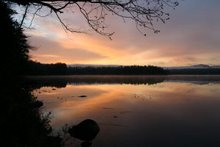
Here is the before view. Quite a contrast.
 Here is the before view. Quite a contrast.

 We woke this morning to yet another damaged bird feeder. I don't know why I bother. These little hand-like prints in the dew on the steps identified the culprit.
 The adventure part is finding the correct channel through the reeds and grasses at the southern end of the flow. We did it right coming back but going from the flow to the river we didn't do so well. Here are W and Cindy saying "there has to be a channel here somewhere".
 I had the brilliant idea that a recent satellite view would be better than our old maps so I was trying to follow it. But since I didn't know where I was most of the time, that didn't help much. W's instincts were better, but we led him astray. After fighting through narrow channels lined with alders and pulling over a large downed tree, we managed to find the river. We paddled down to the lean-to on the Northville-Lake Placid trail for a relaxing lunch. Then we turned around and headed back.
 Sometime when we don't spend so much time looking for the channel, I'd like to explore more of the river. Maybe next year.
 Dr. Edward Livingston Trudeau and some of his descendants are buried in the church graveyard. Trudeau was a pioneer in the wilderness cure of tuberculosis.
 After leaving the church, we went to Paul Smith's College and saw the location of the old Smith's Hotel and of some of the cottages built for guests. Then we had lunch in the Paul Smith's cafeteria prior to launching our boats on Lower St. Regis Lake. We paddled into Spitfire Lake
 and pulled up next to Rabbit Island where we saw this plaque.
 It reads: "On this island in 1886 Dr. Edward Livingston Trudeau conducted his historic experiment to determine the effect of environment on the incidence and progress of tuberculosis in a colony of rabbits. This plaque was placed by Trudeau Institute, Inc. in commemoration of this pioneering study in experimental epidemiology."
 The entrance to the outlet from Cheney Pond is so shallow we had to get out and pull our boats, carefully avoiding soft spots where others have gone in to their thighs. We paddled the outlet for a bit, then had to get out again to carry around rocks. There is a path through the bushes on the left that made this possible. Definitely a good thing we had our single kayaks. The river itself was very nice.
 But we did encounter several beaver dams. Going downstream we only had to get out and carry around one dam, with some nice rides through holes in others. But coming back upstream there was another we had to carry around since the current was so strong. At the spot where the dam used to be we got out on the east side and climbed up the rocks to get this view of the high peaks. It was a great place for lunch.
 The total round trip paddle was about 6 miles, which was plenty given the effort it took. It is also possible to go upstream a 1/2 mile or so from the outlet from Cheney Pond, but we didn't do that.
 We paddled just a bit into Canada Lake then went down the outlet through Lily Lake and all the way down to the dam at Stewart's Landing and then back for a total of 9 miles.
 We took our single boats. It was the most I have paddled in mine but I managed to keep up pretty well.
 And he has sanded the bottom and one side, which did not take as much time as we had feared.
 There is a bit more epoxying to do and we still hope to do that soon. And W will try to finish the sanding too. After reading the instructions on the marine varnish (of which we need 5 coats with wet sanding in between) and learning that it should not be applied when it is humid - yeah, right - we decided we will take the boat to NJ to do that part, probably next spring. Maybe we will have a spectacular fall with crystal blue skies and low humidity which would cause us to rethink that decision, but given the weather up until now, that seems highly unlikely. Besides, if the weather were like that, I would want to be paddling every day.